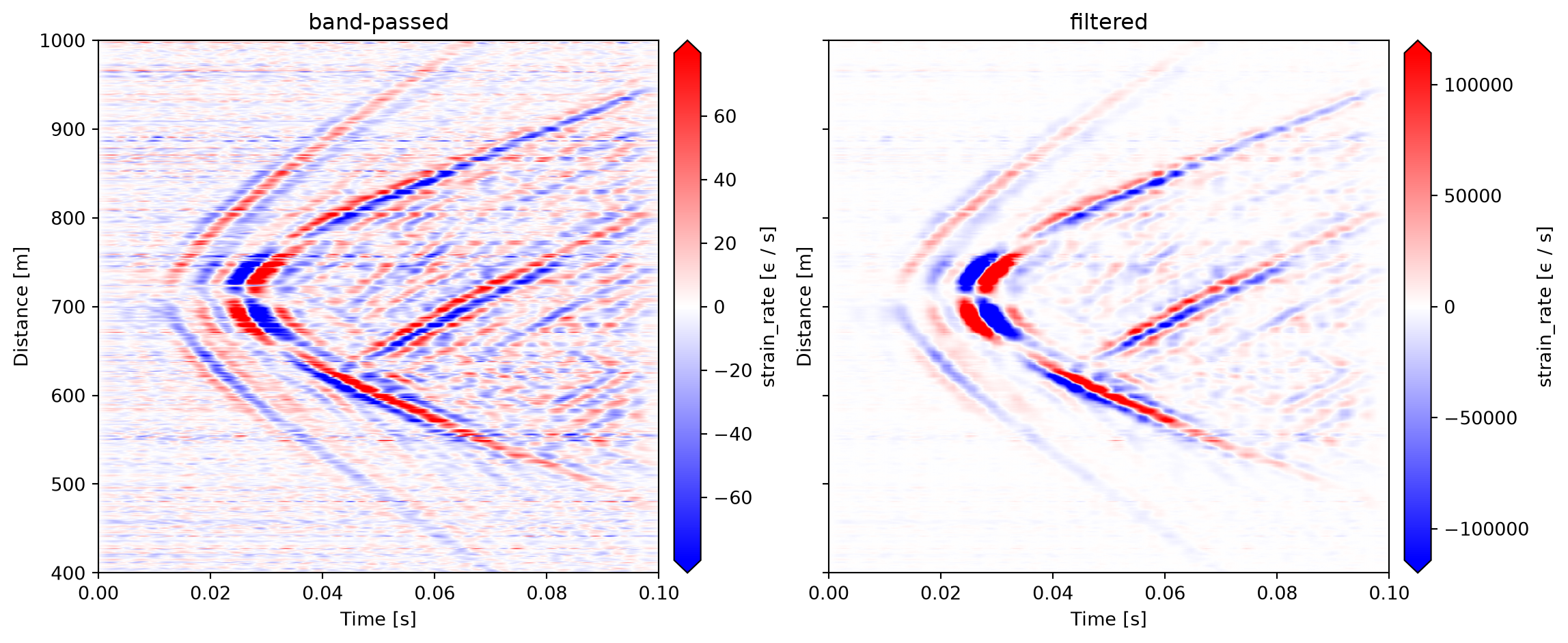
Patch.adaptive_spectral_filter implements the adaptive frequency-wavenumber filter of Isken et al. (2022). It weights each window’s Fourier coefficients by magnitude and blends the windows, favoring coherent arrivals over spectrally diffuse noise.
import numpy as npimport matplotlib.pyplot as pltimport dascore as dcpatch = dc.get_example_patch("example_event_2").pass_filter(time=(1, 300))filtered = patch.adaptive_spectral_filter(time=16, distance=16, samples=True)def show(axes, patches, titles):"""Each patch on its own colour scale: the filter does not keep amplitude."""for ax, patch, title inzip(axes, patches, titles): scale = np.percentile(np.abs(patch.data), 99) patch.viz.waterfall(ax=ax, scale=scale, scale_type="absolute", cmap="bwr") ax.set_title(title) axes[0].figure.tight_layout()fig, axes = plt.subplots(1, 2, figsize=(12, 5), sharey=True)show(axes, [patch, filtered], ["band-passed", "filtered"])
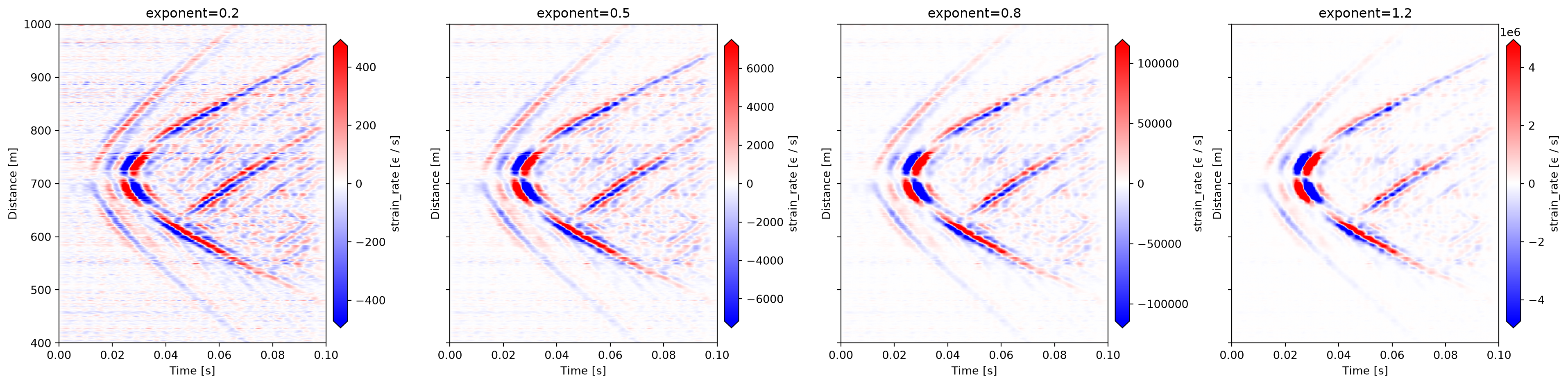
exponent defaults to 0.8 and overlap to the window’s maximum. Window sizes use coordinate units unless samples=True; one dimension filters each trace independently.
Choosing the exponent
Zero leaves data unchanged; values above one may suppress weak coherent arrivals.
The filter does not preserve amplitude or remove coherent noise. Compare arrivals within one result, and remove striping, ringing, or surface waves first.
References
Isken, Marius Paul, Hannes Vasyura-Bathke, Torsten Dahm, and Sebastian Heimann. 2022. “De-Noising Distributed Acoustic Sensing Data Using an Adaptive Frequency-Wavenumber Filter.”Geophysical Journal International 231 (2): 944–49. https://doi.org/10.1093/gji/ggac229.