import tempfile
from pathlib import Path

import numpy as np
import dascore as dc

output_data_dir = Path(tempfile.mkdtemp())
sp = dc.get_example_spool().update().sort("time")
dt = 1
cutoff_freq = 1 / (2 * dt)
filter_safety_factor = 0.9
memory_limit_MB = 1_000
tolerance = 1e-3Low-Frequency Processing
Keywords
filtering, low pass, low frequency, downsampling
Low-pass, downsample, and write a spool within a memory budget while trimming filter-edge artifacts.
Inputs
Chunk size and edge effects
Reserve space for processing copies and a safety margin. Profile the workflow to tune processing_factor; filtering plus interpolation uses about five here.
processing_factor = 5
memory_safety_factor = 1.2
patch_size = (
    memory_limit_MB * dc.units.megabytes / (processing_factor * memory_safety_factor)
)
Process an impulse and measure where its response exceeds tolerance of the peak:
pa_chunked_sp = sp.chunk(time=patch_size, keep_partial=True)[0]
chunk_size = pa_chunked_sp.seconds
delta_pa = dc.get_example_patch("delta_patch", dim="time", patch=pa_chunked_sp)

delta_pa_low_passed = delta_pa.pass_filter(time=(None, cutoff_freq * filter_safety_factor))
new_time_ax = np.arange(
    delta_pa.get_coord("time").min(),
    delta_pa.get_coord("time").max(),
    np.timedelta64(dt, "s"),
)
delta_pa_lfp = delta_pa_low_passed.interpolate(time=new_time_ax)

data_abs = np.abs(delta_pa_lfp.data)
threshold = np.max(data_abs) * tolerance
ind = data_abs > threshold
ind_1 = np.where(ind)[1][0]
ind_2 = np.where(ind)[1][-1]

delta_pa_lfp_length = delta_pa_lfp.seconds
time_ax_abs = (new_time_ax - new_time_ax[0]) / np.timedelta64(1, "s")
time_ax_centered = time_ax_abs - delta_pa_lfp_length // 2

edge = max(np.abs(time_ax_centered[ind_1]), np.abs(time_ax_centered[ind_2]))

if np.ceil(edge) >= chunk_size / 2:
    raise ValueError(
        f"The calculated `edge` value ({edge:.2f} seconds) is greater than half of the processing patch size "
        f"({chunk_size:.2f} seconds). To resolve this and increase efficiency, consider one of the following:\n"
        "- Increase `memory_size` to allow for a larger processing window.\n"
        "- Increase `tolerance` to reduce the sensitivity of artifact detection."
    )
Process and write
sp_chunked_overlap = sp.chunk(time=patch_size, overlap=2 * edge, keep_partial=True)

for patch in sp_chunked_overlap:
    pa_low_passed = patch.pass_filter(time=(..., cutoff_freq * filter_safety_factor))
    new_time_ax = np.arange(
        pa_low_passed.get_coord("time").min(),
        pa_low_passed.get_coord("time").max(),
        np.timedelta64(dt, "s"),
    )
    pa_lfp = (
        pa_low_passed.interpolate(time=new_time_ax)
        .update_coords(time_step=dt)
        .select(time=(edge, -edge), relative=True)
    )

    pa_lf_name = pa_lfp.get_patch_name()
    path = output_data_dir / f"{pa_lf_name}.h5"
    pa_lfp.io.write(path, "dasdae")
Select a bounded time or distance range before merging when the complete result may exceed memory.
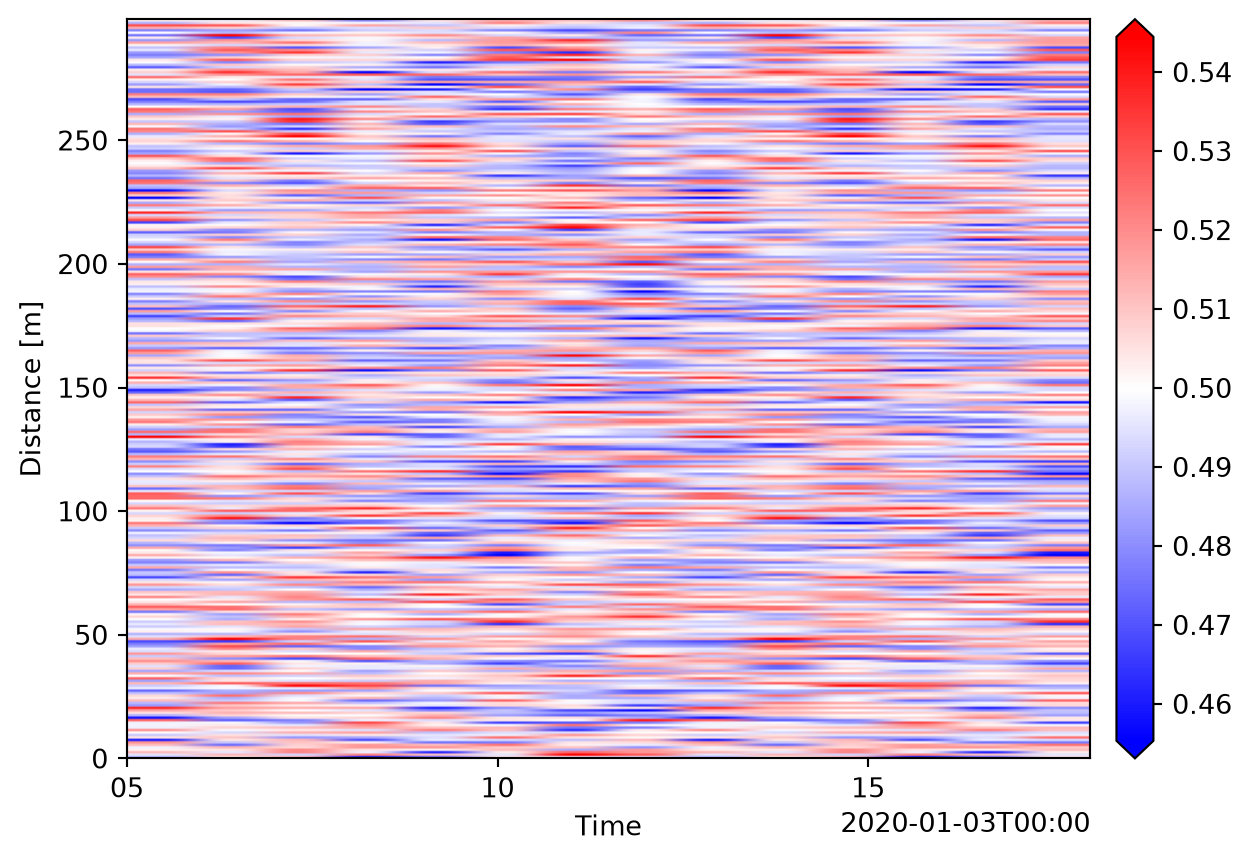
Visualize
sp_lf = dc.spool(output_data_dir)
sp_lf_merged = sp_lf.chunk(time=None, conflict="keep_first")
pa_lf_merged = sp_lf_merged[0]
pa_lf_merged.viz.waterfall()