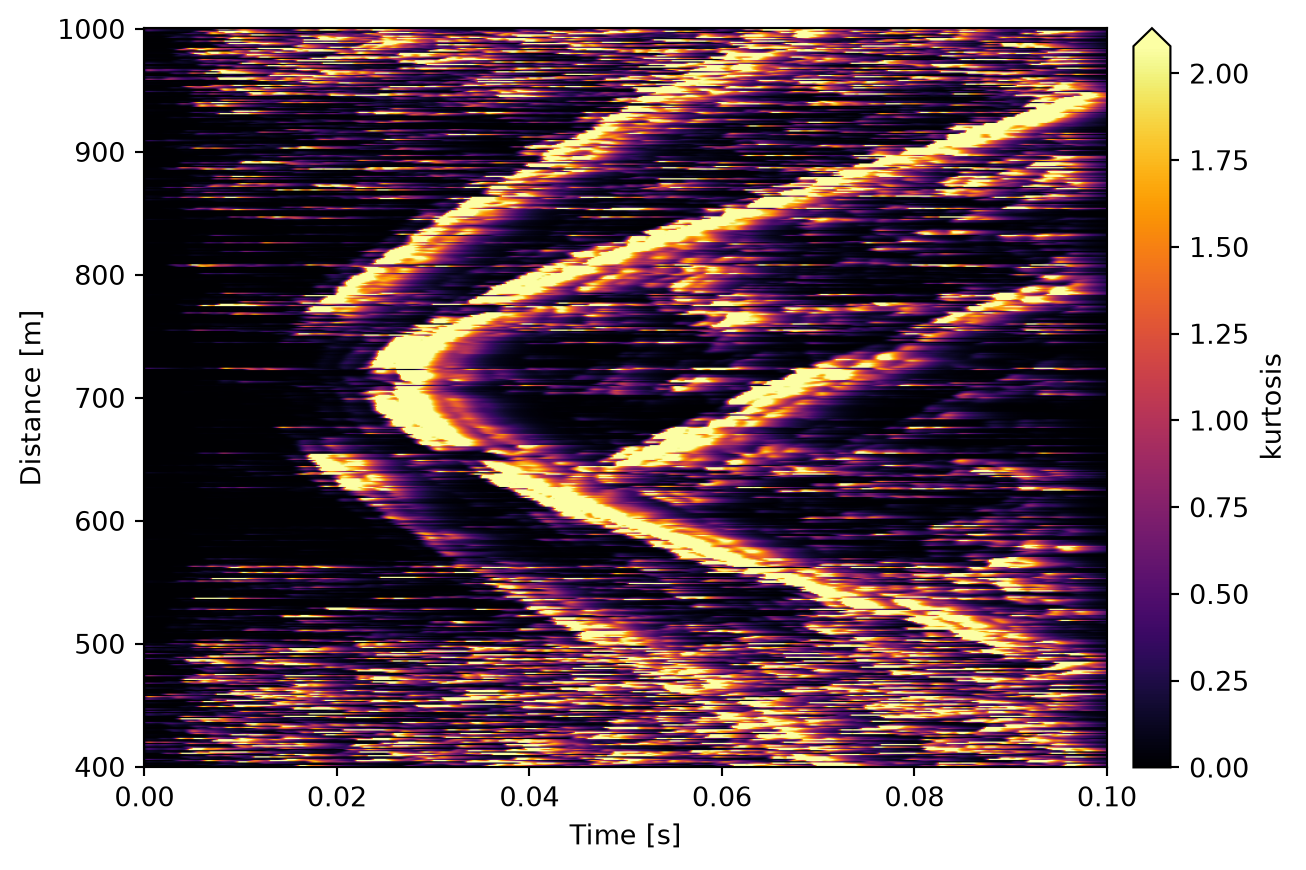
Seismic arrivals are more impulsive than approximately Gaussian background noise, so their windowed amplitude distribution has higher kurtosis. This makes kurtosis useful for detecting arrivals, especially P-wave onsets.
Parameters
Parameter
Description
patch
Input DASCore patch.
samples
If True, the values in kwargs and step represent samples along a dimension. Must be integers. Otherwise, values are assumed to have same units as the specified dimension, or have units attached.
recursive
Use the recursive pseudo-kurtosis of Langet et al. (2014), an exponentially weighted estimator that avoids storing sliding windows. False computes ordinary windowed kurtosis.
**kwargs
Dimension and window length, such as time=0.5 or distance=10 * dascore.units.m.
Returns
PatchType A new patch with kurtosis traces.
Examples
import dascore as dcimport numpy as nppatch = dc.get_example_patch("example_event_2")kurtosis = patch.kurtosis(time=0.002)_ = kurtosis.viz.waterfall(cmap="inferno")# Amplify a block of Gaussian noise to create an impulsive onset.rng = np.random.default_rng()data = rng.normal(size=patch.shape)data[:, 300:450] *=3synthetic = patch.update(data=data)onset = synthetic.kurtosis(time=0.002)
Run the operation: check, get_metadata, kernel, reconcile, record.
References
Langet, Nadège, Alessia Maggi, Alberto Michelini, and Florent Brenguier. 2014. “Continuous Kurtosis-Based Migration for Seismic Event Detection and Location, with Application to Piton de la Fournaise Volcano, La Réunion.”Bulletin of the Seismological Society of America, 229–46. https://doi.org/10.1785/0120130107.